Inspect a cooled sample
Warm muffins are still changing. Steam escapes, the crumb firms and a cut surface may compress under the knife. Let a representative sample cool before making a texture diagnosis, and record the waiting time. Compare muffins from different pan positions if you suspect uneven heat. One muffin next to a juicy berry may not represent the entire batch.
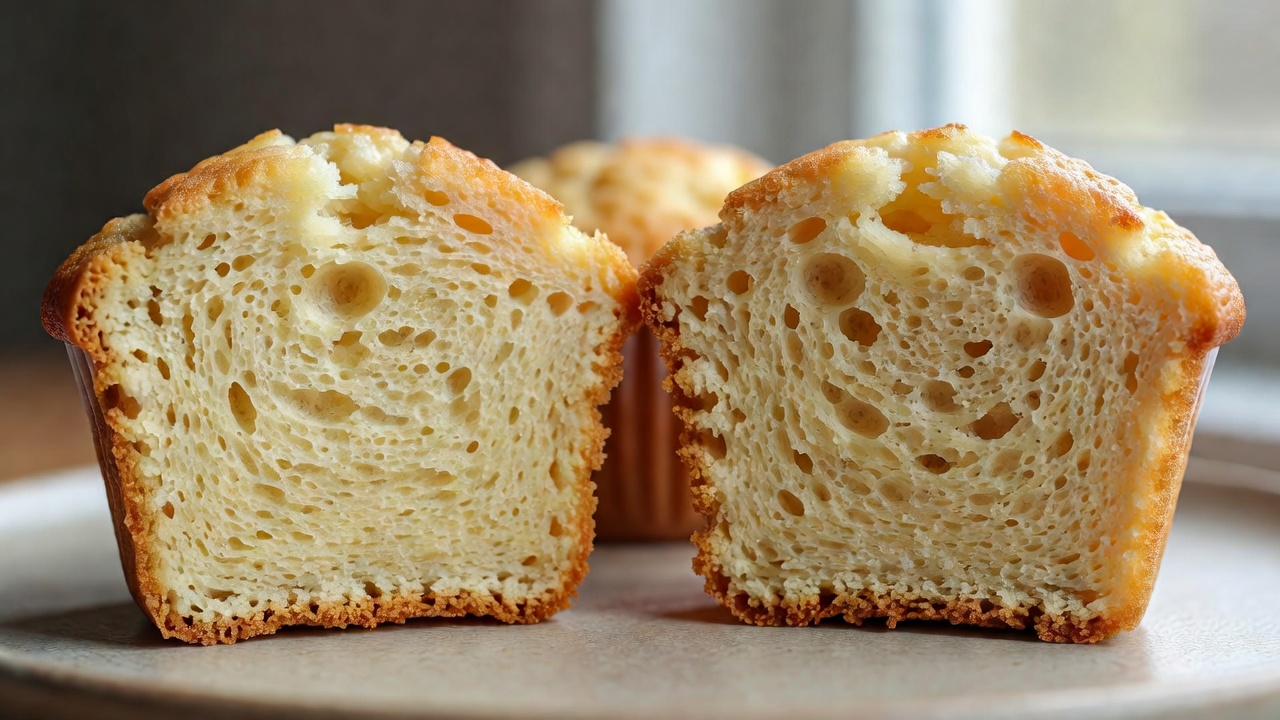
Cut vertically through the centre with a sharp knife. Look at the top, middle, base and edges separately. Is the crumb evenly fine, full of long channels, or compact only beneath fruit? Does it spring gently, crumble into dry fragments, or smear? These observations are more useful than a single label such as “bad texture.” Photographs help, but lighting can make a moist surface look raw.
Dense is a description, not a cause
A short, close crumb may follow from excess flour, insufficient leavening, heavy additions, poor aeration or a formula intended to be substantial. Review the recipe before assuming a fault. A bran muffin will not necessarily resemble a light cake-style muffin, and that difference can be intentional.
If your usual recipe suddenly became dense, check measurement first. Scooping a packed cup of flour can change the balance. Check whether the baking powder was measured correctly and stored well. A quick fizz test may show that a leavener reacts, but it does not prove it will perform optimally in a particular batter. Repeating the unchanged recipe with carefully weighed ingredients may be the most useful next experiment.
Read tunnels alongside the method
Long, vertical channels can be associated with excessive mixing after wheat flour meets liquid, especially when combined with a stiff batter. But no crumb feature identifies one cause with certainty. Leavening quantity, batter consistency and oven conditions can also influence the internal structure.
For a standard muffin-method recipe, combine wet and dry mixtures with controlled, brief folding until dry pockets disappear. A slightly uneven surface is not an invitation to beat the batter smooth. Recipes using a creaming method are different: they intentionally develop aeration before flour is added. Follow the chosen method rather than applying a universal stir count.
Separate wet pockets from an unset centre
A glossy patch around fruit can be local moisture rather than a uniformly underbaked muffin. A broad, paste-like centre deserves a different response. Check more than one sample and compare the fruit-free crumb. A skewer can pass through a gap or pick up melted chocolate, so its result needs interpretation alongside structure and the recipe’s doneness cues.
Do not taste raw batter as a diagnostic tool. Raw flour and eggs can carry harmful microorganisms. The US Food and Drug Administration’s raw-flour guidance is a useful safety reference. Appearance alone cannot establish microbiological safety, and adding a few minutes later is not a reliable rescue plan for every mishandled batch.
What should I change first if the centre seems unset?
First confirm the recipe quantities, portion size and oven setup. If they match the reference, compare a slightly longer bake while watching the edges. Avoid changing liquid, leavening and temperature together.
Look at dry edges and collapsed tops separately
Dry edges can follow from a long bake, dark conductive pans, small portions or a formula with too much flour. If the centre is acceptable but the outside is hard, inspect pan material and portion consistency before adding more liquid. If the entire muffin is dry after cooling, compare the ingredient weights and the point at which baking stopped.
A sunken top may reflect a centre that did not set enough to support the structure, excess leavening, an overly wet formula or a major disturbance during baking. “Do not open the door” is not a complete explanation. Record when the collapse occurred: inside the oven, immediately after removal or during cooling. Timing helps narrow the next test.
Why did the liners become damp underneath?
Steam can condense when muffins remain in the pan or are sealed while warm. Allow an appropriate short pan rest, then transfer them carefully to a rack. Follow the recipe for fragile or unusually wet muffins.
Choose one next step
A useful diagnosis ends with a testable decision, not a list of every possible mistake. If the flour measurement is uncertain, weigh it next time. If only the back row browned heavily, investigate oven position. Keep the other variables steady and write down whether the predicted improvement actually appeared.
Rose Levy Beranbaum’s The Baking Bible and Wayne Gisslen’s Professional Baking provide broader baking context, though this page is not a substitute for a recipe’s tested method. For a home routine that reduces uncertainty before troubleshooting begins, continue to Repeat a Reliable Batch.
Prepare a crumb observation