Make the reference easy to repeat
A favourite recipe can drift gradually: a different flour bag, a larger scoop, a new pan, a slightly more generous handful of fruit. None of those changes is necessarily wrong, but together they can make a once-familiar result hard to explain. Save a clean reference version and annotate changes separately instead of rewriting the original every time.
Record the yield, pan size and ingredient quantities in the units the recipe uses. If you convert cups to grams, use ingredient-specific information from the recipe’s author where available. A cup of flour and a cup of sugar do not share one universal weight. The International System of Units provides a common measurement language, but good measurement still depends on suitable tools and technique.
Weigh with the scale you actually have
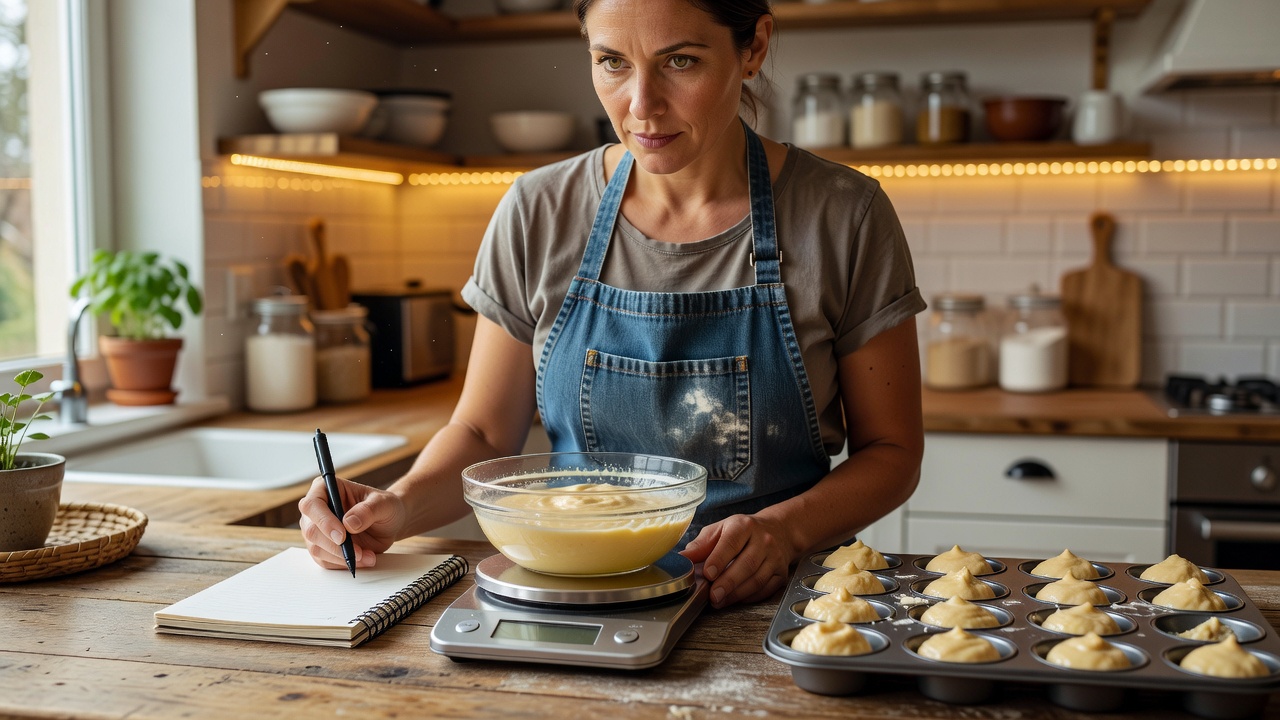
Place the scale on a stable, level surface and check that it returns to zero. Tare between additions, and pause before pouring so an overshoot does not become an unnoticed formula change. Record eggs as specified by the recipe; if precise comparison matters, note the edible egg weight rather than relying only on a size label.
Most household scales are less useful for very small leavening quantities than for flour or milk. Use appropriate measuring spoons when the scale cannot resolve the amount reliably, and level them consistently. Do not claim more precision than your equipment can provide. “Approximately” is sometimes the most accurate word in a kitchen notebook.
Standardise the pan and portions
Pan material, colour and cavity size affect heat transfer and the shape of the batter. A dark metal pan and a flexible silicone mould are not interchangeable controls. Keep the same pan for a comparison, note whether liners were used, and place it on the same rack. If you change pans, treat that as the experiment.
Portion by weight when you want closely comparable muffins. A spring scoop is convenient, but batter density and the way you fill it can change the amount delivered. Weigh a few filled cavities or portions to check your routine. Avoid overfilling to force a particular shape; the recipe’s intended yield is usually a better starting point.
A small pre-bake checklist
Treat the oven setting as a starting point
An oven’s displayed temperature is a control setting, not a complete account of the heat reaching your pan. Preheat according to the appliance instructions and the recipe. An oven thermometer can help reveal broad discrepancies, but position and cycling affect its reading. Record a pattern rather than chasing every momentary fluctuation.
Conventional and fan-assisted settings move heat differently. Follow the recipe’s stated mode when possible and consult your appliance guidance for adjustments. Avoid a universal temperature subtraction: ovens and recipes vary. If the back row consistently colours faster, record that pattern and test a planned rotation at an appropriate stage rather than moving the pan repeatedly.
Start checking near the recipe’s suggested window, using several cues together. Colour, a set centre, gentle spring and an appropriate skewer result can all contribute. None alone guarantees that every formulation is done. Document the actual bake duration and any unusual door openings.
Control cooling and storage too
The batch is not finished as an experiment when it leaves the oven. A long stay in the hot pan can affect the base, while early handling can damage a fragile crumb. Follow the recipe’s cooling instructions and record the time before transferring to a rack. Compare samples after the same cooling interval.
For next-day comparisons, store samples under matching conditions and label them clearly. Sealing warm muffins can trap condensation. Fruit, dairy fillings and other perishable additions may require different storage from a plain muffin, so do not apply one room-temperature rule to every recipe. Consult relevant food-safety guidance, including the US Department of Agriculture, when storage safety is uncertain.
Repeat before you redesign
If a familiar recipe gives an odd result, repeat it once with careful measurement before changing the formula. A single batch may reflect an unnoticed process difference. If the same issue recurs, choose one likely variable and make a deliberate test using Record the Recipe Change.
Consistency does not demand identical weather, an expensive oven or perfect notes. It asks for enough shared conditions that your observations mean something. If a difference remains unexplained, say so. A clear record of uncertainty is more useful than a confident explanation that the batch did not actually test.
Prepare a repeat-batch note